“The aim is not to only test and prove certain evidence but also to build on theory and to better understand what is happening, how it works, for whom, and in what circumstances.” – Suzanne van Hees
SYNCLUSIVE invited me to share experiences about the use of Realist Evaluation to perform the qualitative evaluation of the Living Labs. The Realist Evaluation approach was first developed by Pawson and Tilley (1997) and has since been adapted in many ways. A Realist Evaluation is not just designed to assess whether a program or intervention works or not, but to address questions such as what works (or doesn’t work), for whom (and to what extent), in which circumstances does it work, and how and why does it work. It is a systematic and theory-driven approach to evaluating programs and interventions. It seeks to unveil the underlying mechanisms of how and why programs work in specific contexts. It means, ‘In this particular context, this mechanism generates this outcome.’ This could help to better understand how the four Living Labs ‘work’ and the country and Lab specific context and mechanisms.
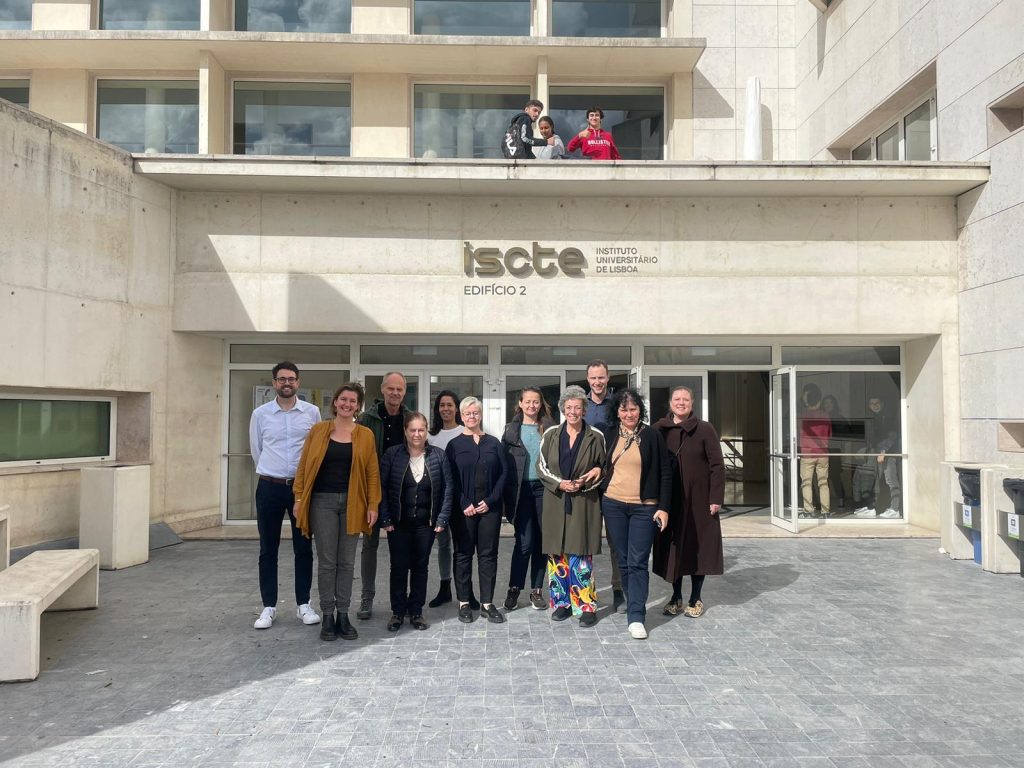
I was delighted to see how committed the SYNCLUSIVE team is to become equipped with the skills needed to embrace this research approach. With the experience from my PhD dissertation “Supporting employees with common mental health problems at work: a realist approach,” I shared important research principles, definitions and its application to a program evaluation. During the training, we used several interactive sessions to activate our ‘realist thinking,’ on easy examples as pictures where to unpack important context, triggering deeper mechanisms, leading to certain outcomes. The presented insights were translated to the SYNCLUSIVE project, for example by developing Initial program theories, propositions about how each Living lab’s interventions may work and the impact they will have on job seekers and employees in vulnerable positions. From the two days we spent together, I observed a group of researchers being very passionate about the ENGINE intervention and to promote upwards and sidewards movement in the labour market. Also, this training supported the group to jointly identify outcomes and to better understand each other’s work context among the involved partners. It was an honour to share my research experience with the SYNCLUSIVE team!